Outdoor speakers that survive the weather.
Outdoor audio fails for two reasons: the speaker was not genuinely rated for permanent exposure, or it was specified as though the garden were a room. Neither is a sound-quality problem — both are specification problems.
What makes outdoors different
There is nothing to reflect sound back
Indoors, walls and a ceiling return energy toward the listener. Outdoors there is none of that, so level falls roughly 6dB with every doubling of distance and a speaker must work considerably harder for the same perceived loudness. This is why sensitivity, not wattage, is the number that decides whether a terrace is properly covered.
"Weather-resistant" is not a rating
An IP figure is a measurable standard; a marketing adjective is not. IP66 means fully dust-tight and protected against powerful water jets from any direction — the correct specification for permanent exposure. Separately, coastal sites need marine treatment, which addresses salt corrosion rather than water ingress.
Cable trenching decides the layout
Reaching a wall near the building is straightforward. Reaching a point in open lawn means a trench, regardless of which speaker sits at the end of it. That is why landscape rock speakers are reserved for positions that genuinely need coverage far from any wall — the trench, not the speaker, is the real cost.
What we’d specify here.
Camphor 6
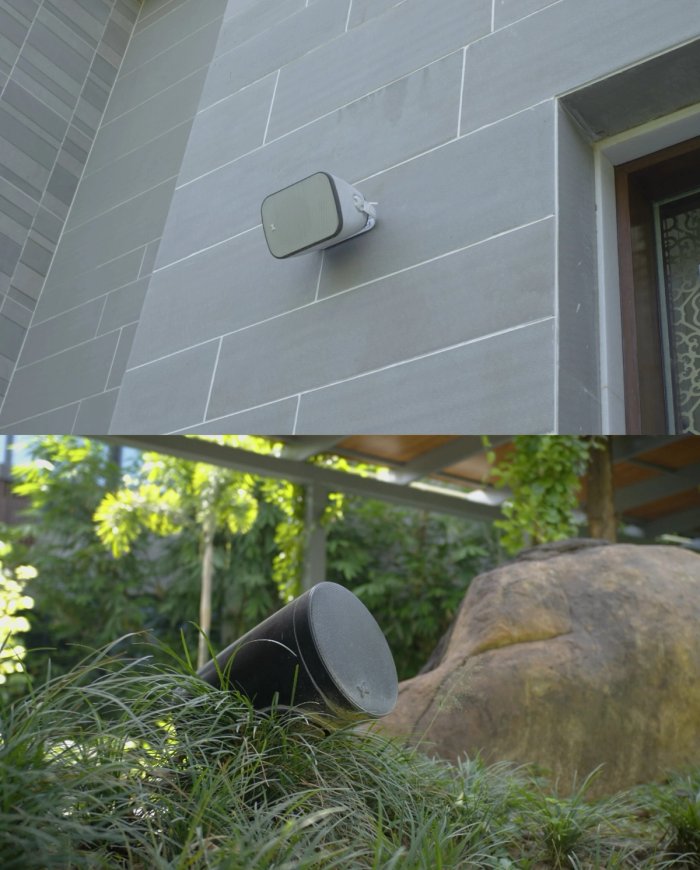
Wall-mount workhorse for terraces and facades: 70W RMS, 87dB, 37Hz–22kHz, IP66 and marine-treatable. Camphor 8 extends to 30Hz where more low end is wanted.
View Camphor 6 →Spirea
A landscape speaker in a rock-form enclosure, IP66-rated, for coverage in planting beds and lawns where no wall exists — 70W RMS, 87dB, 50Hz–22kHz.
View Spirea →Cane
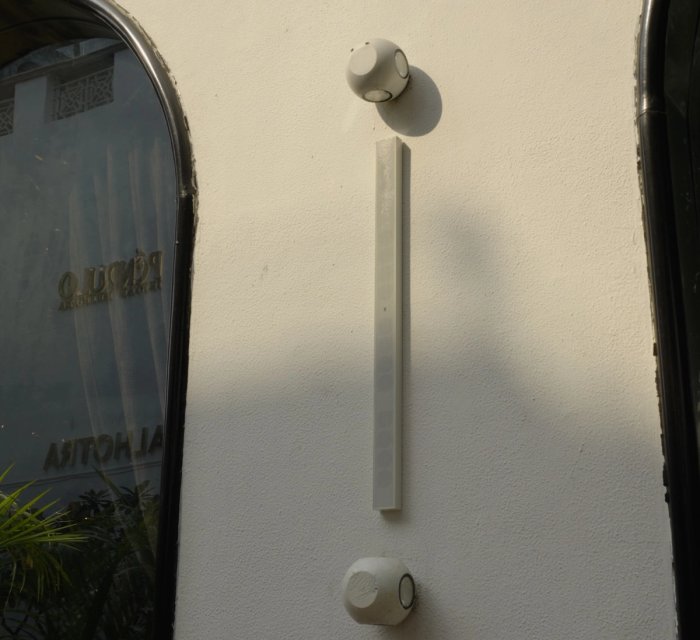
IP66 at only 23mm deep, so the same model used indoors can continue onto a covered terrace or facade without switching product lines mid-project.
View Cane →Banyan Canopy
For large landscaped grounds: a 6-driver line array at 600W RMS and 96dB, paired with the Banyan Pith dual-12" subwoofer where an estate needs genuine scale.
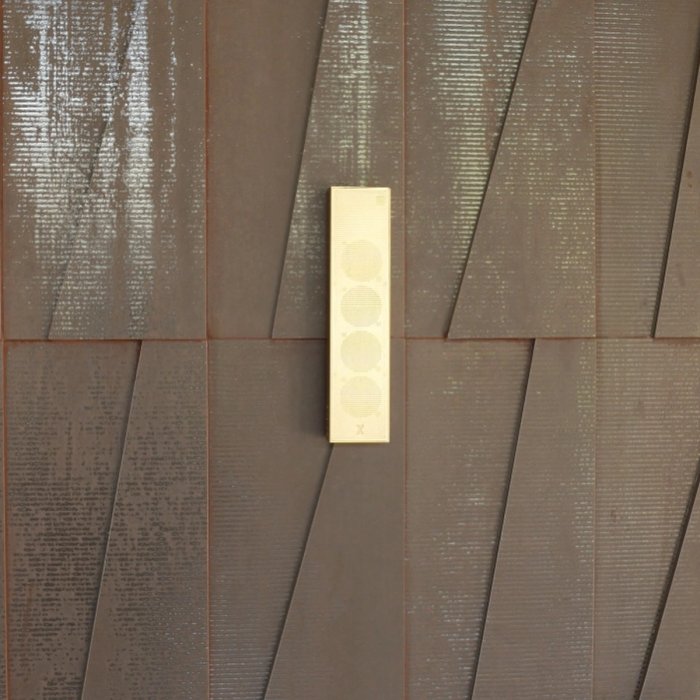
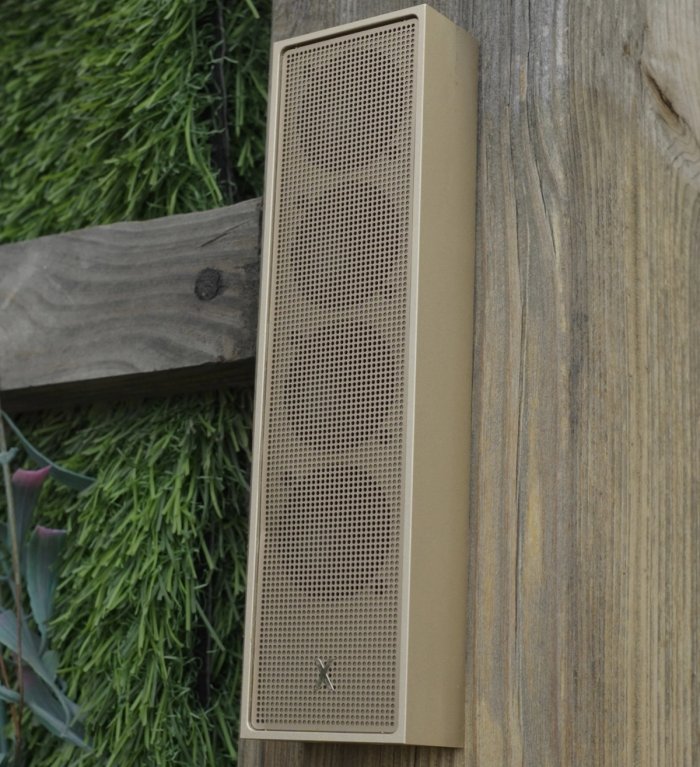
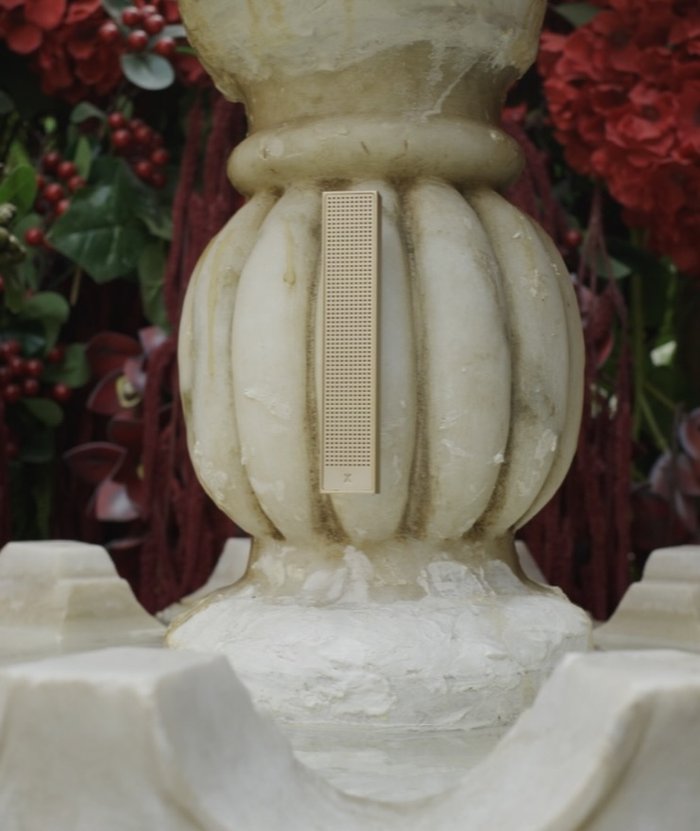
View Banyan Canopy →Real outdoor & garden installations.
Outdoor & Garden questions.
What IP rating do outdoor speakers need?
IP66 for permanent, fully exposed installation — dust-tight and protected against powerful water jets from any direction. Covered terraces under a solid roofline can use a lower rating, but IP66 removes the judgement call. Products described only as weather-resistant, with no IP figure, are making an unverifiable claim.
Why do outdoor speakers need to be more powerful than indoor ones?
Open air has no walls or ceiling to reflect sound back toward listeners, so level drops roughly 6dB for each doubling of distance. A garden therefore needs higher sensitivity or more power than an indoor room of equivalent floor area.
What is a landscape or rock speaker?
A speaker built into a rock-shaped enclosure so it can sit directly in planting beds or lawns and blend with the landscaping. It solves coverage in open garden areas where there is no wall to mount to — XSCACE Spirea is IP66-rated for exactly this.
Can I use the same speakers indoors and outdoors?
Yes, if they carry an outdoor rating. Cane is IP66 at 23mm deep, so a single product line can run from an interior room out onto a covered terrace. Keep the zones on independent volume control, because outdoor ambient noise levels differ from indoors.